
State Library Victoria × StartSpace Challenge
"How might we reimagine library experiences for young people (12y – 18y) so they feel as captivating, interactive, and immersive as the digital worlds they inhabit - while strengthening meaningful, curriculum-aligned learning"
As part of the challenge, we explored this question through behavioural thinking, journey mapping and service design.
The problem
Digital experiences are designed to remove friction.
Meaningful learning requires the opposite.
What makes someone willingly choose effort?
This shifted the focus away from simply making learning easier or more entertaining, and towards understanding the conditions that make participation feel worthwhile.

Presence is not the same as engagement
A young person can be physically present in a library without being psychologically engaged with it.
They might be studying, waiting, scrolling, chatting, looking around or simply passing time.
Instead of asking only how to get young people into the Library, we looked at what could help someone move from simply being there to becoming curious, participating and wanting to return.
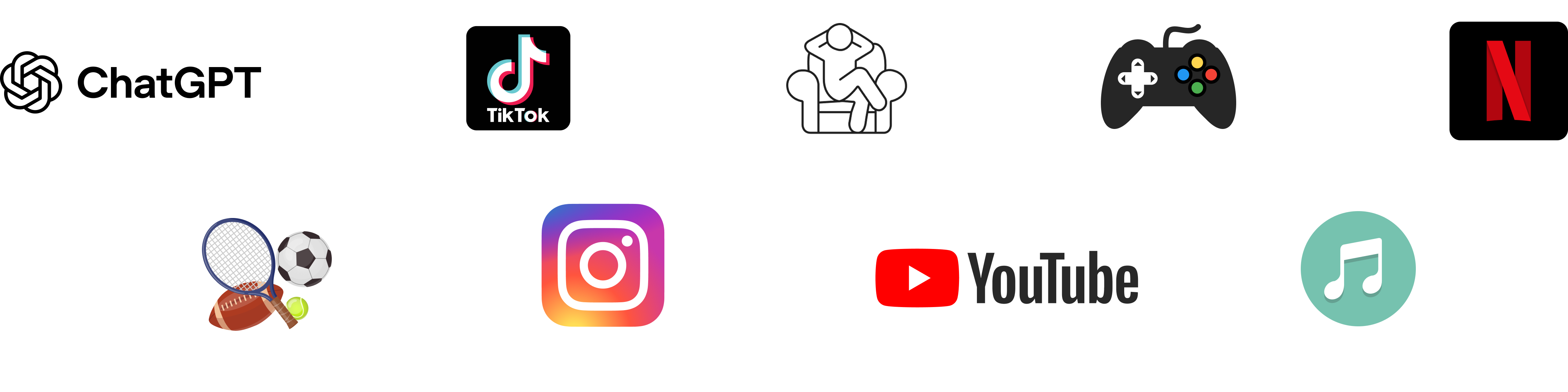
What is the library actually competing with?
But this wasn't enough.
We wanted to understand the teenager's experience beyond the Library - and, more specifically, what they could be choosing instead.
We mapped the everyday alternatives: scrolling, gaming, watching videos, socialising, hanging out, sport and other activities competing for the same limited resource:
attention and willingness to engage.
What emerged surprised us.
Sport stood out from everything.
An activity that requires significant effort while offering high learning value.
That shifted our thinking.

What is it about sport that works?
Is it a sense of autonomy?
Purpose?
Identity?
Belonging?
Contribution?
Recognition?
Competence?
Our observation raised more questions.

The behavioural journey
We focused on teenagers already present in the library and mapped their experience.
From the moment of awareness to the possibility of repeating the experience and creating lasting learning value.
I am here → I notice → I become curious → Is it worth it? → I’ll try → I’m engaged → I feel something → I’ll do it again
It gives us a way to ask where engagement drops off and what would have to happen for someone to move between those stages.
From assumptions to evidence
One of the most important distinctions we explored was between what we know, what we assume, and what we don't yet know.
A young person not participating could mean many different things.
The invitation might be unclear.
The social risk might feel too high.
The effort might feel greater than the perceived reward.
Or we might simply be interpreting the behaviour incorrectly.
The behaviour as an evidence
The next stage would bring the young person's journey together with the Library's own journey.
Then we'd look for:
Where the journeys align?
Where they diconnect?
Where are the opportunities
Micro-experiments
From there, small experiments can help identify what is worth scaling.
The goal isn't to build something impressive.
It's to build something that works.
Our role
Our approach sits between behavioural thinking, UX, journey mapping and business design.
For this challenge, that meant:
Look beyond the immediate experience.
Separate observations from explanations.
Identify where and why engagement may be breaking down.
Use small experiments to learn what actually changes behaviour.
We believe clarity comes before complexity.

